
Search New Orleans Property Records
Property records for New Orleans are held by the Orleans Civil District Court Clerk -- a unique setup in Louisiana where the city and parish share the same boundaries. Deeds, mortgages, conveyances, and other land documents for all New Orleans properties are recorded and searchable through this office. You can search the index online or visit in person to access the full range of Orleans Parish property records, including historical instruments going back many centuries.
New Orleans Quick Facts
Property Records for New Orleans Residents
In Louisiana, property records are held at the parish level -- not the city level. New Orleans is unique. The city and Orleans Parish share the exact same boundaries, so there is no separate parish government to deal with. One set of offices covers everything.
The Orleans Civil District Court Clerk handles all property record filings for the city. This office is the result of a 2014 consolidation that merged three older offices -- the Recorder of Mortgages, the Register of Conveyances, and the Custodian of Notarial Archives. That history matters. Records created before 2014 were originally filed under those older offices, and the current clerk maintains all of them. A deed from 1985 sits in the same system as one recorded last week.
Under La. R.S. 44:1, all property records are public. Anyone can access them. You do not need to be an owner or attorney to search.
Orleans Civil District Court Clerk
The clerk's office sits in downtown New Orleans. Chelsey Richard Napoleon serves as the Civil District Court Clerk. The office handles conveyances, mortgages, liens, judgments, and notarial acts -- all the document types you might need when digging into a property's history.
| Address | 1340 Poydras St., 4th Floor, New Orleans, LA 70112 |
|---|---|
| Phone | (504) 407-0000 |
| cdcclerk@orleanscivilclerk.com | |
| Hours | Monday-Friday, 8:30 AM - 5:00 PM |
| Website | orleanscivilclerk.com |
The screenshot below shows the Orleans Civil District Court Clerk website where you can access property records online. Visit orleanscivilclerk.com to explore the document index and subscription options.
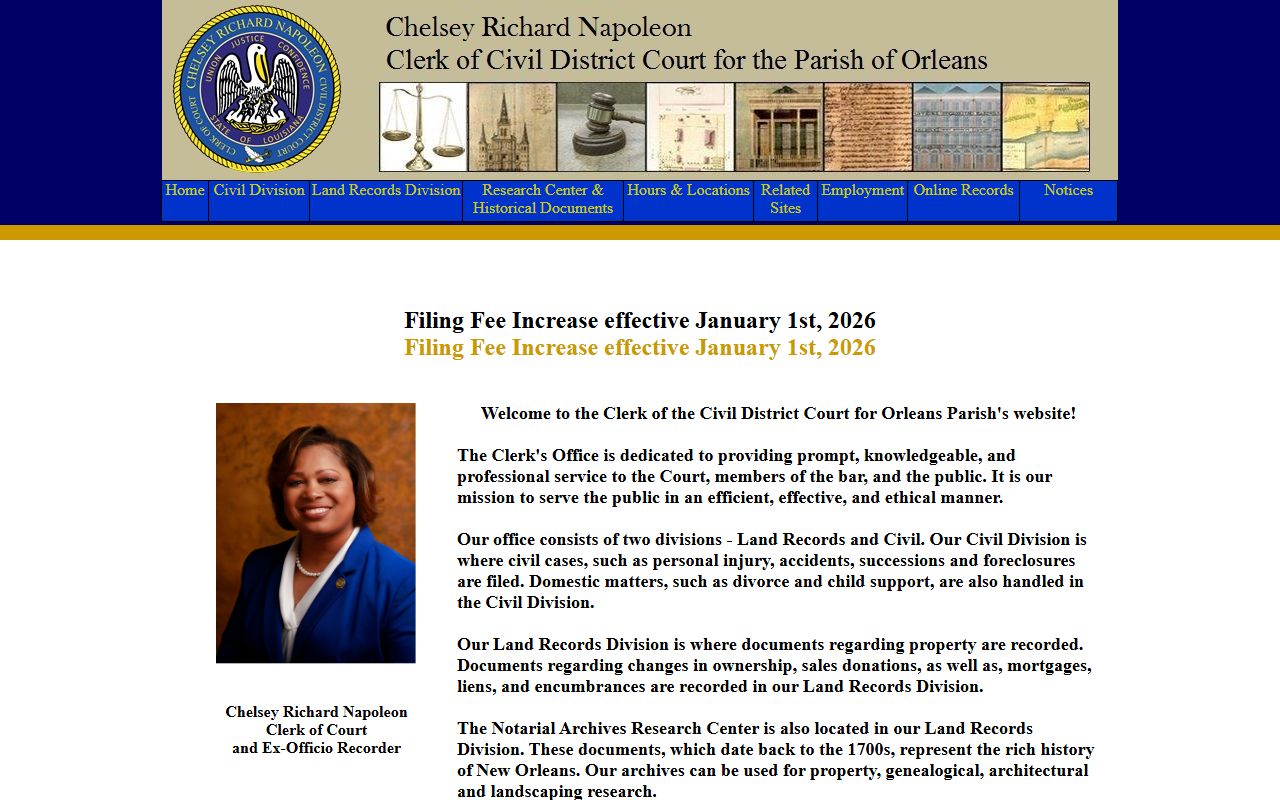
The clerk's subscription portal provides full document access, including images of recorded instruments going back many decades.
In-person searches are free. Walk in, use the public access terminals, and view documents without any charge. Copies cost a fee. Online access through the clerk's paid portal lets you pull documents from your desk, which is useful if you are doing title research or need to review many records quickly.
How to Search Property Records in New Orleans
There are several ways to search. The right choice depends on how many records you need and whether you want full document images or just index data.
Orleans Civil Clerk Online Portal: The clerk's website at orleanscivilclerk.com offers a subscription-based search. This gives you full access to recorded documents with images. It is the best option if you need the actual text of a deed or mortgage, not just the filing information. Most title companies and real estate attorneys use this system.
eClerks LA (free): The statewide index at eclerksla.com lets you search Orleans Parish records by name or instrument number at no cost. You get index data -- grantor, grantee, dates, book and page -- but not document images. Good for confirming that a record exists before paying for the full document.
Clerk Connect (subscription): ClerkConnect.com is a paid statewide option. It pulls records from multiple Louisiana parishes, Orleans included, and is used by those who work across parish lines.
NOLA Property Viewer GIS (free): The city runs a free GIS portal at property.nola.gov. You can look up a property by address, see parcel boundaries on a map, and get basic ownership and assessment data. It won't show deed text, but it is useful for confirming a parcel ID or owner name before going deeper. Visit property.nola.gov to access the map tool.
The screenshot below shows the New Orleans Property Viewer GIS portal for viewing parcel data by address. Visit property.nola.gov to search mapped parcel information at no cost.
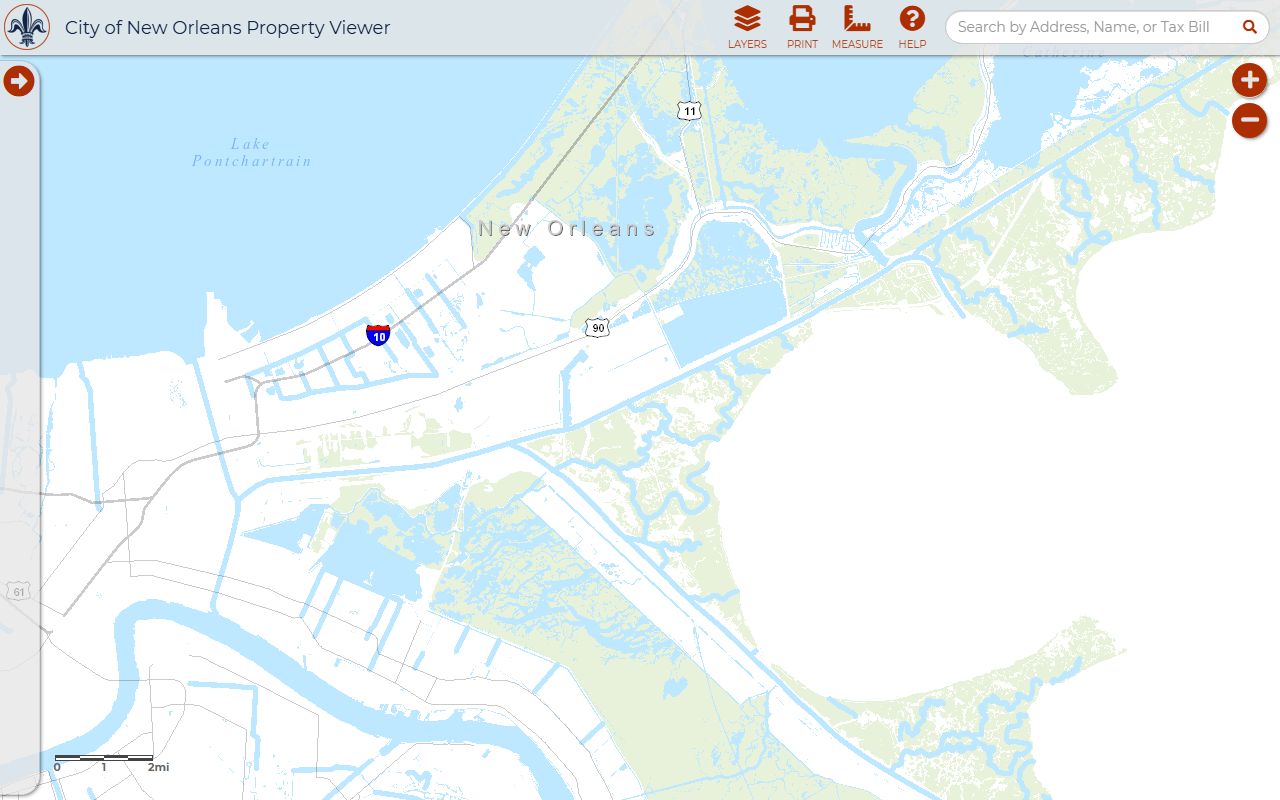
The GIS viewer is particularly useful for confirming lot lines, zoning overlays, and flood zone designations -- all relevant when researching New Orleans properties.
In person: Walk into the clerk's office at 1340 Poydras St. The public terminals are free to use. Staff can direct you to the right index. Bring a property address or owner name -- that is all you need to start.
Orleans Parish Assessor
The Orleans Parish Assessor is Erroll G. Williams. The assessor's office sets the assessed value for every property in the city. That number determines how much you owe in property taxes each year.
| Address | City Hall, Room 4E01, 1300 Perdido St., New Orleans, LA 70112 |
|---|---|
| Phone | (504) 658-1300 |
| Website | nolaassessor.com |
The NOLA Assessor website offers a free parcel search. Enter an address or owner name and pull up assessed value, property class, square footage, and exemption status. No login needed.
Louisiana law sets how assessors calculate value. Under La. Const. art. VII, sec. 18, residential property is assessed at 10% of fair market value, commercial property at 15%, and public service properties at 25%. So a home worth $300,000 carries an assessed value of $30,000. The millage rate then applies to that $30,000 figure. Orleans Parish homeowners who use the property as their primary residence can apply for the homestead exemption, which removes the first $7,500 of assessed value from parish taxes.
Understanding Louisiana Property Records
Louisiana uses a civil law tradition rather than the common law system found in most other states. That shapes how property records work here. The core recording rule comes from La. Civ. Code art. 3338, which says that a transfer of immovable property is not effective against third parties until it is recorded with the proper clerk. If someone sells a house and the buyer never records the deed, a later creditor or buyer could have a stronger claim. Recording is not optional -- it is how you protect ownership under Louisiana law.
Several document types make up a property's recorded history. Conveyances include deeds and acts of sale -- the documents that transfer ownership. Mortgages cover purchase money loans and home equity liens. Judgments can attach to real property as liens. Notarial acts, which are common in Louisiana, are documents executed before a notary public and carry special legal weight. The Orleans Clerk maintains separate indexes for these categories, which is why the 2014 consolidation mattered -- it unified access to all of them under one office.
Public records law -- La. R.S. 44:1 -- sets a strong default rule in Louisiana. All records are public unless a specific exemption applies. Property records rarely qualify for any exemption, so the full record is open to anyone who asks.
Property Taxes in New Orleans
Property tax bills in New Orleans are issued by the City of New Orleans Bureau of the Treasury. Bills are due December 31 each year. Miss that date and interest and penalties start to accrue. The city also offers an installment payment option for homeowners who qualify.
Tax bills go to the address on file with the assessor. If you recently bought property and the address is wrong, update it with the assessor's office before bills go out. You can also pay online through the city's payment portal.
Delinquent tax records become part of the public record. Under La. R.S. 44:411, property tax records are permanently retained. Tax sales -- where the government sells a property's tax lien due to nonpayment -- are also recorded with the clerk's office and appear in any title search. If you are buying property in New Orleans, check for outstanding tax liens before closing. The assessor's site shows current tax status, and the clerk's index will show any recorded tax sale certificates.
The City Planning Commission at 1300 Perdido St. handles zoning questions. Phone: (504) 658-7033. If you need to know the zoning for a specific parcel -- which matters for renovation permits, short-term rentals, and subdivisions -- that office is the right starting point. Zoning records are separate from property ownership records but often come up in the same research process.
Building permits and occupational licenses for New Orleans are tracked through the city's One Stop Shop at nola.gov/onestop. Permits can affect property value and are sometimes relevant to title research, especially for properties that have been renovated or had additions built without proper permits. It is worth checking permit history on any New Orleans property before you buy.
Nearby Cities
These Louisiana cities are also served by parish clerk offices and have their own property records pages.