
Search Louisiana Property Records
Louisiana property records are held at the parish level across all 64 parishes in the state. The Clerk of Court in each parish keeps conveyance records, mortgage filings, and land documents. The parish assessor maintains property values and tax data. You can search Louisiana property records online through statewide portals or go to the clerk and assessor in the parish where the property sits. This guide covers what records exist, who keeps them, and how to find them whether you need a deed, a lien search, or assessment details.
Louisiana Property Records Quick Facts
How Louisiana Property Records Work
Louisiana takes a different path than most states when it comes to land records. The state uses a civil law system rooted in French and Spanish codes rather than English common law. This affects how property ownership is documented, recorded, and searched. Real property records in Louisiana are not held at the state level. Each of the 64 parishes keeps its own land records through two main offices: the Clerk of Court and the parish assessor.
The Clerk of Court is the first place to look for property records. This office records and stores conveyance records, which document ownership transfers like deeds, donations, and exchanges. It also handles mortgage records, which show liens and encumbrances against a property. Under Louisiana Civil Code Article 3338, these documents must be recorded with the clerk to be effective against third parties. An unrecorded instrument has no legal effect on anyone who does not know about it. This is why recording matters so much in Louisiana.
The Louisiana Secretary of State's office at sos.la.gov plays a coordination role but does not hold real property records. It runs the business entity search and manages the statewide UCC database, but your deed and mortgage records stay at the parish level.
The parish assessor works separately from the clerk. The assessor sets the value of each parcel for tax purposes. You can look up a property by address through the assessor. The clerk's records are indexed by owner name. Together, these two offices hold the main property records for each Louisiana parish.
The Louisiana Secretary of State homepage links to several tools that touch on property and commercial records, including the UCC database and the historical archives branch.

The SOS site is the starting point for statewide resources, though real property deeds and mortgages live with the parish Clerk of Court.
Note: Original documents filed with the Clerk of Court are not returned. They become part of the permanent parish archives under La. R.S. 44:411.
Search Louisiana Property Records Online
Louisiana has several ways to search property records from home. The free statewide starting point is eClerks LA at eclerksla.com. This portal covers all 64 parishes and lets you search conveyance and mortgage index data with one login. You can see index entries at no cost. Getting copies of actual documents requires a fee or a subscription depending on the parish. The system also includes eClerks Alert, a free fraud monitoring tool that notifies you if anything is recorded in your name across any of the 64 parishes.
The eClerks LA portal is the product of the Louisiana Clerks' Remote Access Authority, established in 2014. As described on the site, it is a "one-stop shop for doing business with Louisiana Clerks." You get a single username and password to search across all applicable parishes. Index data for mortgage and conveyance records is free and open to the public. Document images cost extra.
The eClerks LA portal is the best starting point for any free statewide index search of Louisiana property records.

The portal includes both mortgage and conveyance record indexes as well as civil information and marriage licenses across all Louisiana parishes.
Clerk Connect at clerkconnect.com serves more than ten parishes with civil, criminal, and property record searches. It runs on a subscription basis. Parishes like Caddo, East Baton Rouge, Jackson, Ouachita, Bossier, Claiborne, and Lafourche use this system for online access to land records. Individual subscriptions are typically $20 per day or $100 per month. Clerk Connect also provides eRecording services for document submissions.
Many parishes run their own portals too. Jefferson Parish offers JeffNet, with over 125 million pages of imaged records going back to 1825. East Baton Rouge has a free GIS property lookup. Lafayette uses its own eSearch system. Beauregard Parish has scanned conveyance records going back to 1913. You can also use QPublic Louisiana as a gateway to assessor websites across the state.
Business and Commercial Property Records
The Louisiana Business Entity Search through the Secretary of State's office is useful when you need to look up a commercial owner or verify a business name tied to a property. This system holds business registrations, officers, and registered agent information for entities throughout Louisiana.

Searching a business name before running a title search can help you confirm the full legal name of any corporate or LLC grantor or grantee that may appear in conveyance records.
The geauxBIZ portal handles business filings and some records online through the Secretary of State. It is separate from real property recording but ties into the commercial side of property transfers involving business entities in Louisiana.

When a deed involves an LLC, partnership, or corporation, verifying that entity's standing through the Secretary of State's records is a key step before completing any title review.
Louisiana Property Tax Assessment Records
The Louisiana Tax Commission oversees property assessment across all 64 parishes. It reviews assessment rolls, measures uniformity, and can order reappraisals if a parish's assessments deviate by more than 10 percent from the required standard. The Tax Commission directly assesses public service properties statewide, which covers utilities, railroads, pipelines, and airlines.
Under the Louisiana Constitution Article VII, Section 18, different types of property are assessed at different rates. Land and improvements for residential purposes are assessed at 10 percent of fair market value. Other property and electric cooperative holdings are assessed at 15 percent. Public service properties carry a 25 percent assessment rate. These percentages apply across all 64 parishes. The Tax Commission's website also has a parish tax rolls database covering assessed values statewide.
The Louisiana Tax Commission is the central oversight body for all property assessments in the state.
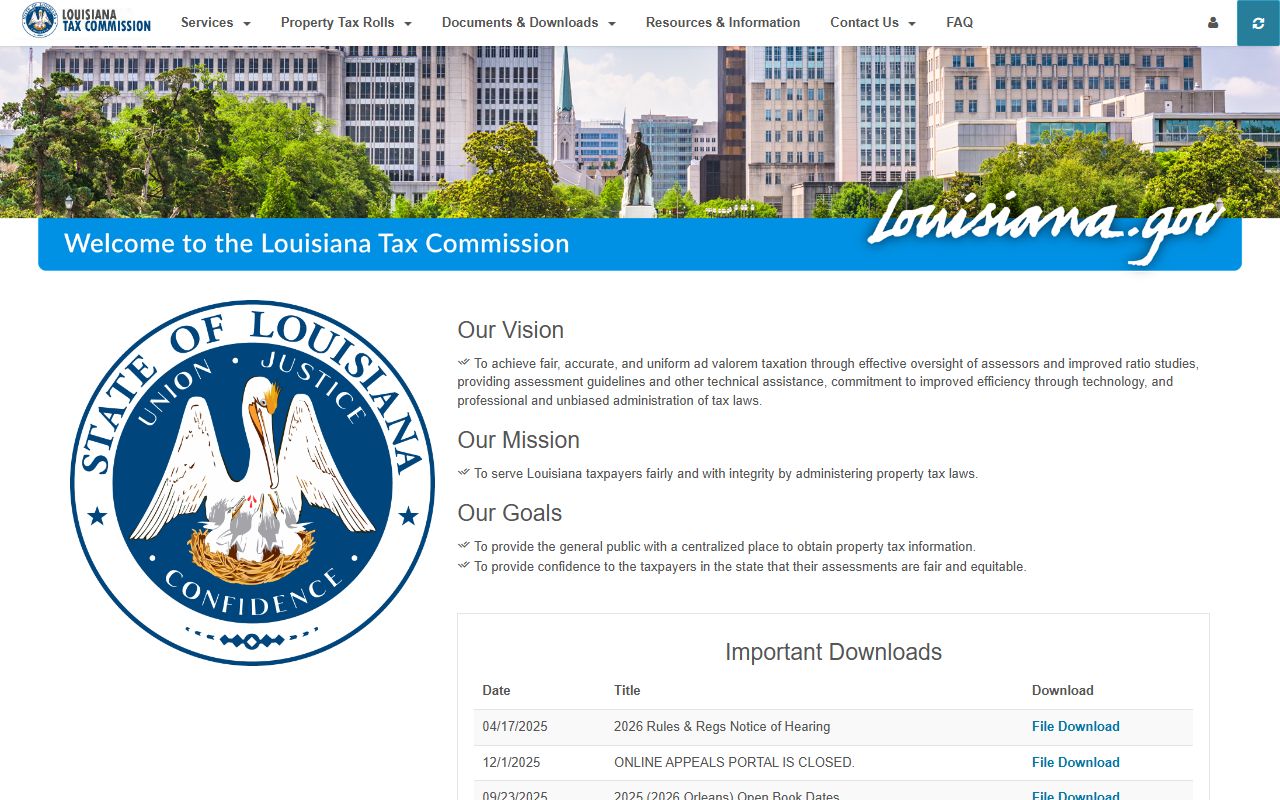
The Tax Commission's site includes information on how assessments are reviewed and how property owners can challenge assessed values through the proper channels.
Each parish assessor holds an annual Open Book period, generally running August 15 through September 15. During this time, property owners can review their assessed values. If you disagree, you must file before the deadline. Appeals go through the local Board of Review first. If still unresolved, they move to the Tax Commission. Contact your parish assessor for specific dates and appeal procedures.
Historical Louisiana Property Records
Two state agencies hold land records that go back much further than most parish systems. The Louisiana State Archives at the Secretary of State's office holds roughly 30,000 cubic feet of historical materials. These include assessment records, colonial documents, passenger manifests for the Port of New Orleans, military service records, and materials from the State Land Office. The archives serve researchers who need historical property chains of title going back to the French and Spanish colonial periods.
The Louisiana State Archives is a critical resource for anyone researching property history that predates the formation of modern parishes.

The archives holds books, manuscripts, photographs, microfilm, and digital collections covering centuries of Louisiana land history that no single parish office can match.
The Louisiana Office of State Lands administers a separate document access system with an impressive scope. It holds land grants, severance documents, U.S. Official Township Survey plats and field notes, and Tract Books. The office states that these records "make up the source of title for every acre of land in Louisiana." The system also includes Property Tax Adjudication documents from 1880 to 1973. Properties adjudicated after 1974 are held by individual parishes.
The Office of State Lands is essential for researchers tracing the original source of title for any Louisiana parcel.
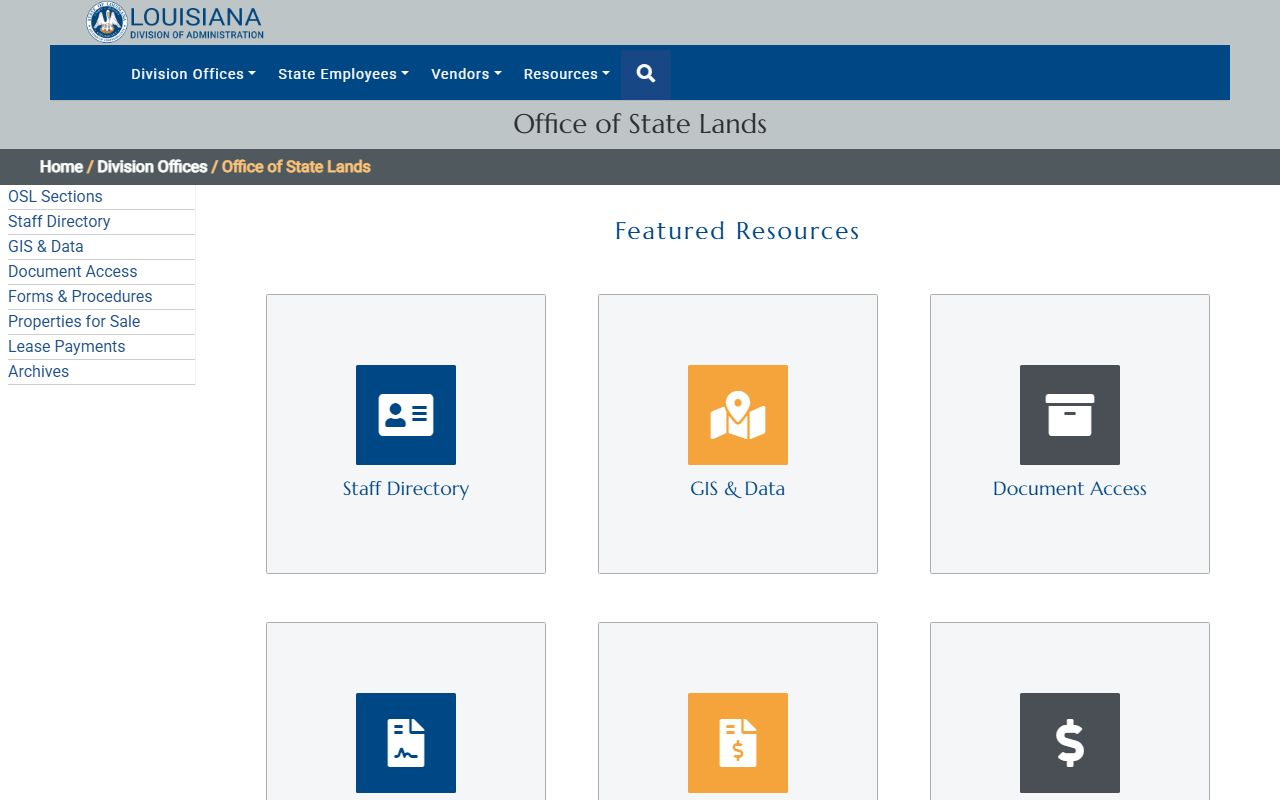
The State Lands office covers every land grant and severance document going back to when Louisiana was public land.
The State Lands Document Access portal lets you search these historical records online for free.
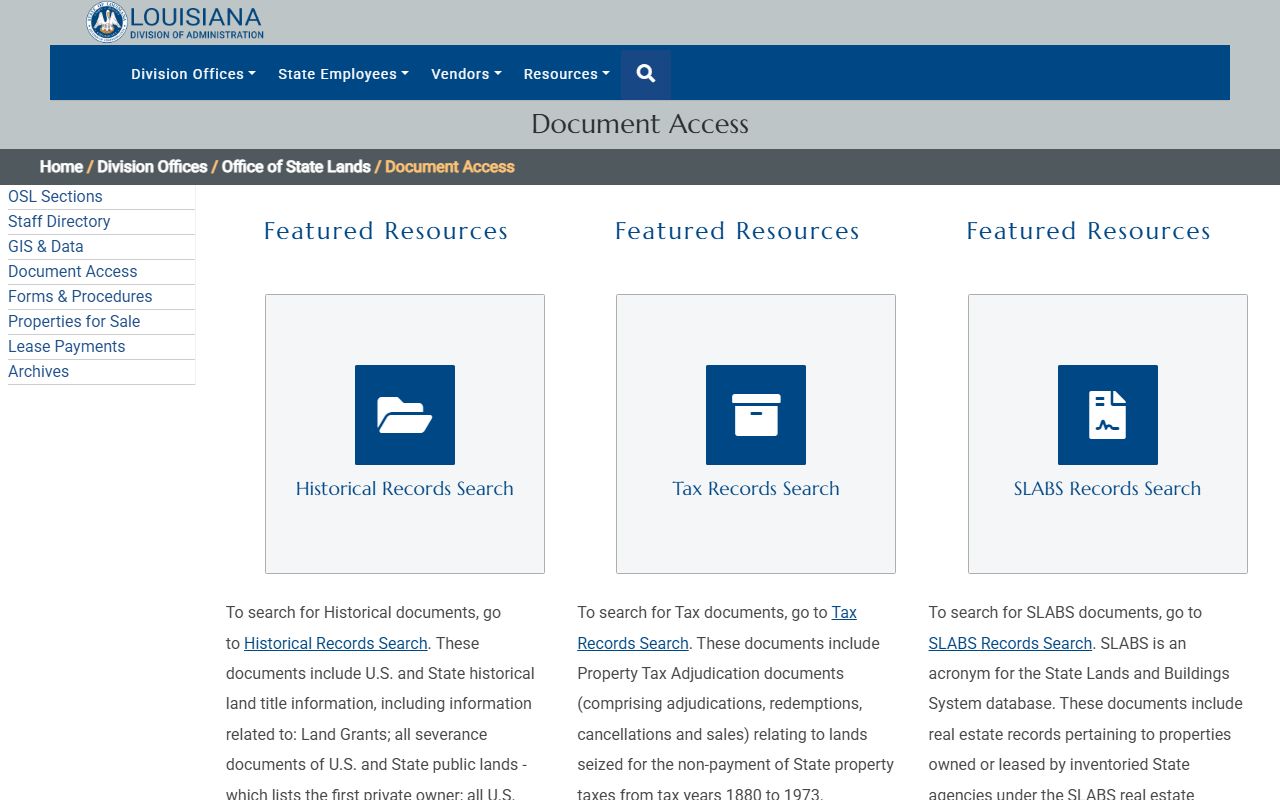
This free portal is one of the most underused resources for title research in Louisiana, especially for rural parcels and properties near state or federal land boundaries.
UCC Filings and Louisiana Property Records
Louisiana handles UCC financing statements differently than any other state. In nearly every other state, UCC-1 filings go to the Secretary of State's office. In Louisiana, they go to any of the 64 Parish Clerks of Court. Filers can choose whichever parish is most convenient regardless of where the debtor lives or where the collateral is located. The Secretary of State maintains a central statewide database of all filings, but the original documents go to the parish clerk. Louisiana was the last state to adopt the UCC in 1990 and took a different path from the start.
UCC-3 amendments, continuations, and assignments must be filed in the same parish as the original UCC-1. Any forms sent to the Secretary of State's office are returned unfiled. You can identify which parish holds a particular filing by looking at the first two digits of the UCC file number. For example, East Baton Rouge filings begin with 17 and Orleans Parish filings start with 36. The SOS site at sos.la.gov explains the full system and fee schedule.
The Louisiana UCC information page on the Secretary of State's site explains the full filing system, fees, and how to search the statewide database.
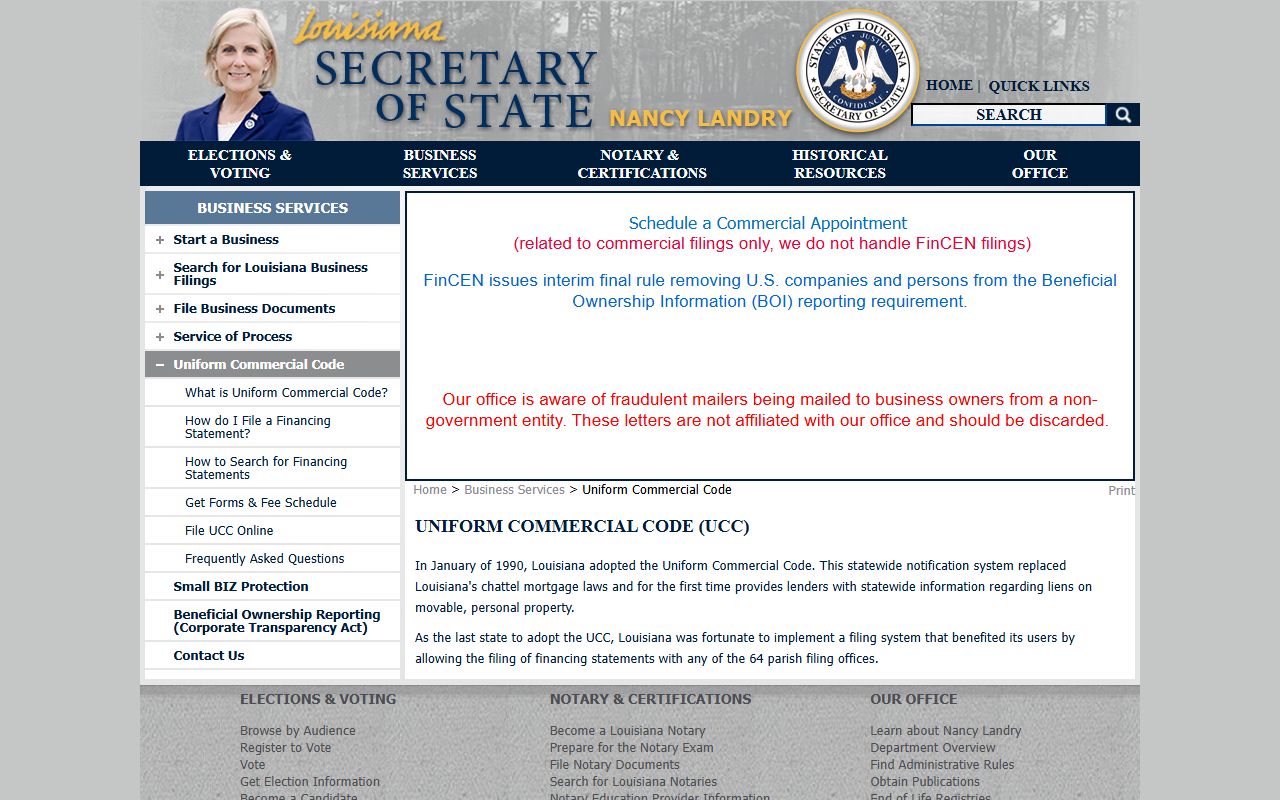
A UCC search certificate costs $30 per debtor name, and annual database subscriptions are available for $400 per year for unlimited searches.
Note: A UCC-1 Financing Statement covers personal property. It is different from a mortgage on real estate. Both types of liens show up in property records searches but are indexed and stored in different ways at the Clerk's office.
Louisiana Property Recording Laws
Louisiana Civil Code Article 3338 is the foundation of the state's recording system. Under this statute, rights created by instruments that transfer immovable property, establish real rights, or involve leases have no effect on third parties unless the instrument is recorded in the appropriate mortgage or conveyance records. This is called the Public Records Doctrine. It means an unrecorded deed is void as to any third party who does not have notice of it. Recording is not just helpful in Louisiana. It is what makes the transfer legally effective against the world.
Under La. R.S. 44:1, all property records held by public bodies are public records. Anyone can request to see them. You do not need to be a party to the transaction. You do not need to state a reason. R.S. 44:411 requires parish clerks to keep conveyance, probate, and mortgage records permanently. These records are never destroyed. They are Louisiana's permanent archive of every land transfer since each parish was established.
Documents must typically be in authentic form to be accepted for recording. This means a notarial act signed by the parties and two witnesses, or an act under private signature that has been duly acknowledged. Recording fees vary by parish but follow a general schedule set by state law. As of 2017, fees run from $110 for documents up to five pages to higher amounts for longer instruments. Contact the specific parish clerk for their current fee schedule.
Browse Louisiana Property Records by Parish
Each of the 64 Louisiana parishes has its own Clerk of Court and assessor who maintain local property records. Select a parish below to find clerk contact info, assessor links, online search portals, and more.
View All 64 Louisiana Parishes
Property Records in Major Louisiana Cities
Residents of major cities file property documents at their parish Clerk of Court. Select a city below to learn which parish handles records for that area and how to access them online.