
Orleans Parish Property Records Search
Orleans Parish property records are held by the Civil District Court Clerk in New Orleans, which consolidated three offices in 2014 -- the Recorder of Mortgages, the Register of Conveyances, and the Custodian of Notarial Archives. Deeds, mortgages, conveyances, notarial acts, and other land documents are all searchable through the clerk's online portal or in person at the Civil Courts Building on St. Charles Avenue. The Orleans Parish Assessor also provides separate ownership and valuation data for all property in New Orleans.
Orleans Parish Quick Facts
Orleans Parish Civil District Court Clerk
Chelsey Richard Napoleon serves as the Clerk of the Civil District Court for Orleans Parish. This office is the primary custodian of property records in New Orleans. In 2014, the three historical offices that handled property records were consolidated into this single clerk's office. The consolidation brought together the Recorder of Mortgages, the Register of Conveyances, and the Custodian of Notarial Archives, all now operating under one roof.
The clerk's office is located at 1340 Poydras Street, 4th Floor, in downtown New Orleans. It is open Monday through Friday, 8:30 AM to 5:00 PM. Online access to recorded documents requires a subscription through the Civil Clerk's website at orleanscivilclerk.com. Subscribers can search the index and view digitized instruments remotely. In-person access is also available during business hours for anyone who comes to the office.
Under La. Civ. Code art. 3338, recording with the proper office is what makes a conveyance or mortgage binding against third parties. In Orleans Parish, this means recording with the Civil District Court Clerk. Acts of sale, mortgage acts, releases, servitudes, mineral leases, and other property instruments must all be recorded here to be fully effective.
The image below shows the Orleans Parish Civil District Court Clerk's website, which is the main portal for recorded property documents in New Orleans.
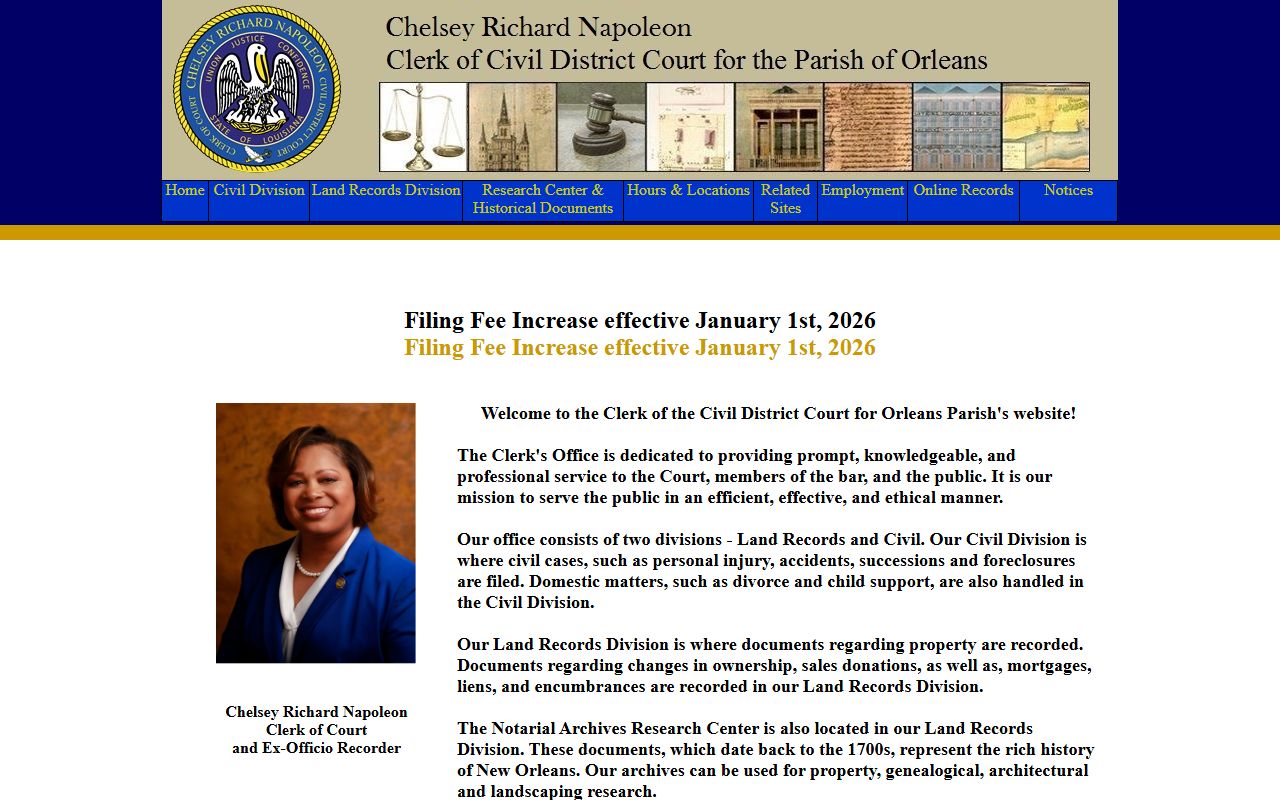
Visit orleanscivilclerk.com to set up an online account and search recorded conveyances, mortgages, and notarial archives for Orleans Parish.
| Clerk | Chelsey Richard Napoleon |
|---|---|
| Address | 1340 Poydras St., 4th Floor, New Orleans, LA 70112 |
| Phone | (504) 407-0000 |
| cdcclerk@orleanscivilclerk.com | |
| Hours | Monday through Friday, 8:30 AM to 5:00 PM |
| Website | orleanscivilclerk.com |
Orleans Parish Assessor
Erroll G. Williams serves as the Assessor for Orleans Parish. His office is at City Hall, Room 4E01, 1300 Perdido Street, New Orleans. The assessor values all real and personal property in the parish for tax purposes. Orleans Parish is unique in Louisiana because the parish and city share the same boundaries. The assessor serves the entire city-parish government area.
Under La. Const. art. VII § 18, homestead property is assessed at 10% of fair market value, commercial property at 15%, and other taxable property at 25%. The assessor's office at nolaassessor.com provides an online property search tool. You can find current assessed values, ownership data, and property descriptions without visiting City Hall.
The image below is from the Orleans Parish Assessor's website at nolaassessor.com.

Use the assessor's search tool at nolaassessor.com to look up parcel values and ownership information for any property in New Orleans.
| Assessor | Erroll G. Williams |
|---|---|
| Address | City Hall, Room 4E01, 1300 Perdido St., New Orleans, LA 70112 |
| Phone | (504) 658-1300 |
| Website | nolaassessor.com |
NOLA Property Viewer and GIS Tools
The City of New Orleans provides a free GIS mapping tool called the NOLA Property Viewer. This tool is available at property.nola.gov and does not require a login or subscription. You can search by address or parcel number to see ownership data, lot dimensions, zoning classification, and aerial imagery. It is one of the most useful free property tools in Louisiana.
The Property Viewer pulls data from multiple city systems. You get assessor data, permit history from the One Stop Shop system, and zoning designations from the City Planning Commission, all on one screen. For someone doing due diligence on a New Orleans property, this is the first tool to check. It does not show recorded deeds or mortgages, but it gives you the baseline parcel data fast.
The image below shows the NOLA Property Viewer GIS tool, taken from property.nola.gov.
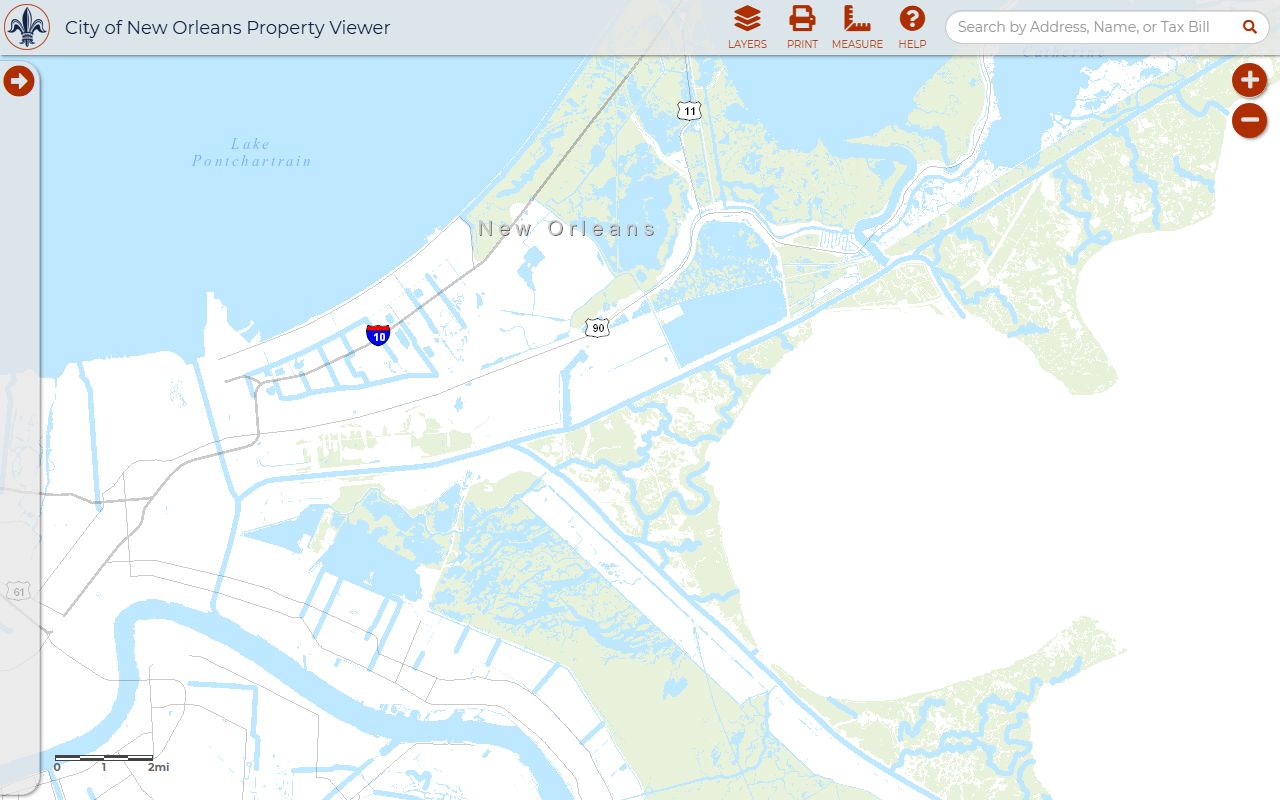
Access the free NOLA Property Viewer at property.nola.gov for interactive maps, ownership details, and zoning data for Orleans Parish properties.
The New Orleans City Planning Commission at nola.gov/city-planning/ handles zoning matters, land use changes, and subdivision applications. If you need zoning verification or are researching a proposed development, the Planning Commission's records are a key secondary source.
The image below is from the New Orleans City Planning Commission site.
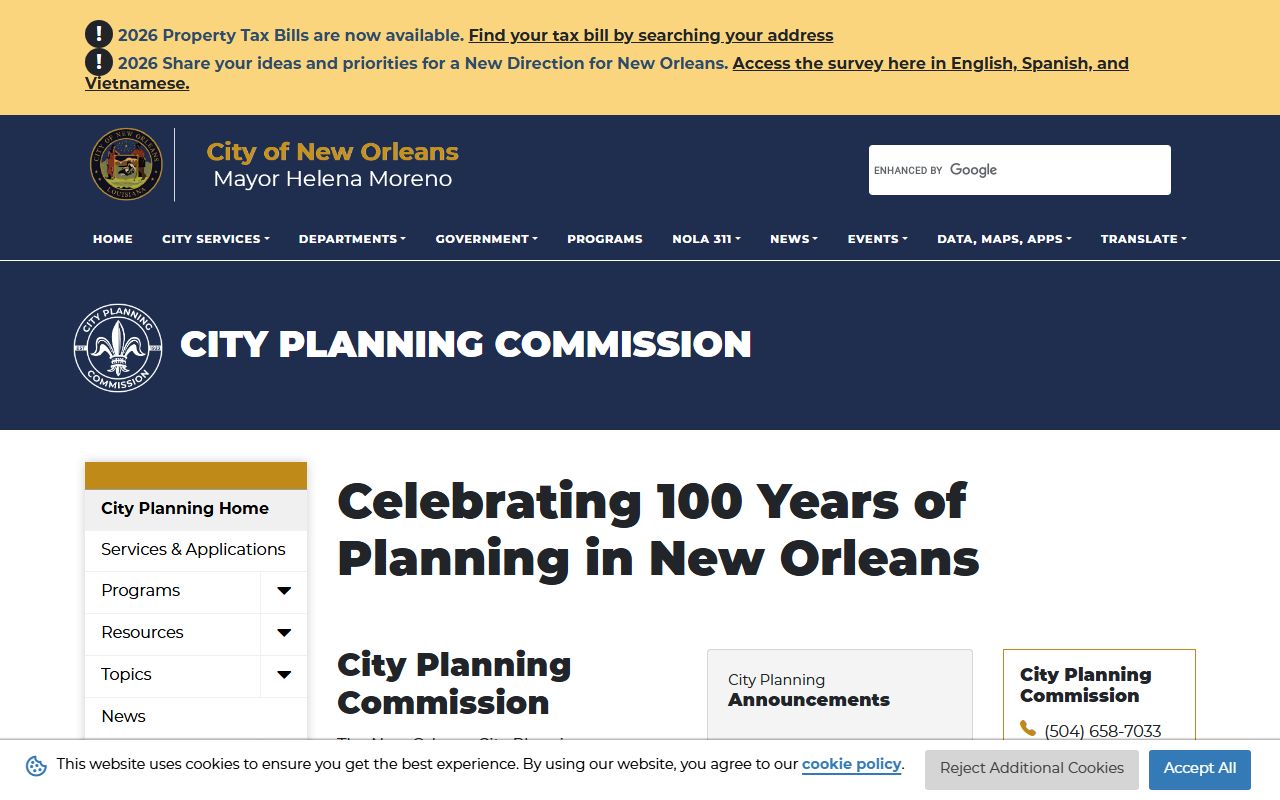
Visit nola.gov/city-planning/ for zoning maps, variance applications, and land use decisions affecting Orleans Parish properties.
Property Record Types in Orleans Parish
Orleans Parish has a uniquely deep recording history. The Notarial Archives division of the Civil District Court Clerk preserves notarial acts going back to the French colonial period. These historic records include acts of sale, successions, marriage contracts, and other documents prepared by New Orleans notaries. Many are available in digitized form through the clerk's office.
Modern property records filed with the clerk include the same instruments as every Louisiana parish, but the volume in Orleans is much higher. New Orleans is one of the most active real estate markets in the state. Acts of sale, mortgage acts, releases, and amendment agreements are filed daily. The consolidated clerk's office handles all of them.
Common property record types in Orleans Parish include:
- Acts of sale and dation en paiement
- Mortgage acts and collateral mortgage pledges
- Mortgage cancellations and partial releases
- Judgment liens and writs of fieri facias
- Servitudes and right-of-way grants
- Notarial acts from historic colonial and antebellum periods
- Lis pendens notices and seizure filings
- Succession and judgment of possession transfers
- Condominium regime declarations and amendments
- Tax sale certificates and redemption acts
Under La. R.S. 44:1, these documents are public records. Anyone can search them. Online access through the clerk requires a subscription. In-person access is free of search fees, though copy fees apply per page.
Permits and Additional Resources
New Orleans operates a One Stop Shop for permits and licenses at nola.gov/onestop/. This is where you find building permit history, code enforcement actions, and business license filings tied to a property address. Permit records are useful when buying property. They tell you whether past work was permitted and inspected.
The eClerks LA statewide portal is another option for searching Orleans Parish recorded documents. Check that site for availability and date range. Some users find it easier to navigate than the clerk's own subscription system.
The Louisiana Tax Commission handles assessment oversight for all parishes including Orleans. If you have a dispute about the assessed value of a New Orleans property that the assessor's office cannot resolve, the Tax Commission is the next step. The commission also publishes statewide assessment roll data that includes Orleans Parish parcels.
Cities in Orleans Parish
Orleans Parish and New Orleans share the same boundaries. All property in the parish is within the city of New Orleans. There are no separate incorporated municipalities within Orleans Parish.
Nearby Parishes
These parishes border Orleans Parish. Property research near parish lines may require checking records in more than one location.